
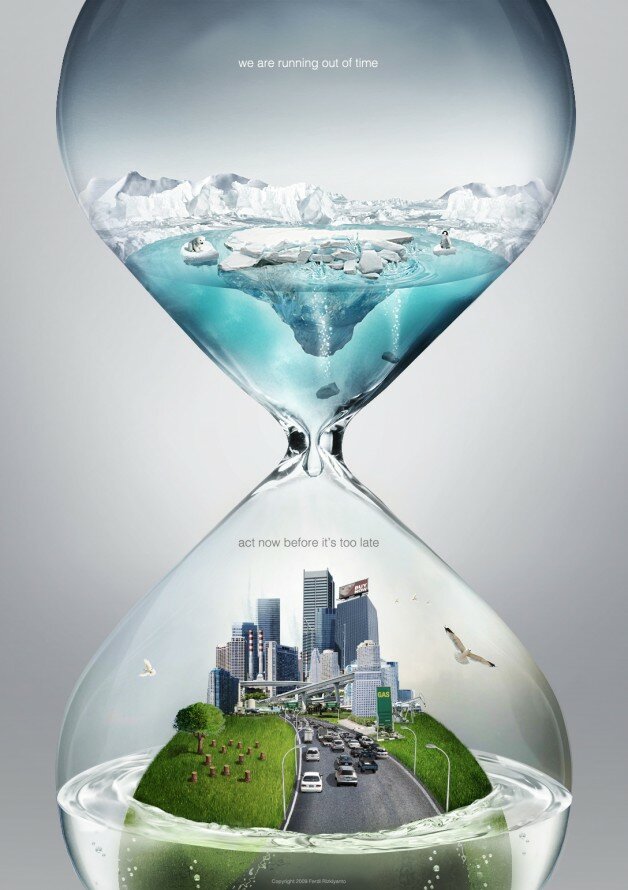
Humans have always displayed the ability to progress individually and collectively towards an evolving vision of society, with a continuous evolution of the way we live, work, produce and consume. But it has become explicit that our conventional lifestyles have lead to an unsustainable future: increasing lack of water and food resources, climate change and global warming, depletion of fossil fuels, accumulation of toxic wastes, deforestation and endangerment of global biodiversity are everyday reminders of our growing impact on earth… Hence, sustainable and environmental issues have become vivid matters in the three key spheres of business, political and societal. To address these issues and initiate the required changes, decision makers, business leaders, NGO activists and each and every citizen must reach for their creative capabilities so as to challenge the way we live and establish new societies able to sustain the existence of our own civilisation.
Arts and sustainability: a mutually beneficial marriage
As an old Indian saying goes: “We do not inherit the Earth from our Ancestors, we borrow it from our Children”. Projecting ourselves, individually and as a whole, in the future world in which we will (or not) want us and our children to live in, appeals to our collective imagination as much as to our individual sense of questioning and responsibility. Still, sustainability raises a variety of reactions between citizens: a few have proactively started to take action, some may interrogate themselves about their everyday consumption behaviours (ex. meat industry), while others may passively fear the future that awaits. But the sad truth is, most people still display a frustrating indifference.
In this context, what can “sustainably-aware” individuals do? Beyond everyday waste sorting, careful use of water and energy, how does one act in favour of these compelling issues? What could possibly trigger mass awareness of sustainability issues?
Deeply reliant on imagination and creativity, conveying strong messages and with high graphic potential (water, waste, energy, biodiversity…), sustainability issues are more than suitable for artistic transposition. Indeed, whatever the considered media (drawings, sculptures, installations, architecture, digital arts, movies…), arts are a fantastic opportunity to represent environmental issues, denounce situations of the world we live in, illustrate new ideas and provide emotional lasting experiences with the potential of reaching and impacting the masses.
Although (too) few in number, sustainably-aware artists, usually with limited notoriety, have leveraged their artistic skills as an opportunity to express their pessimistic, realistic or enthusiastic feelings, their innovative ideas and, possibly, their dreams about a greener future. Whatever the name given to it, “Conscious art”, “green art”, “sustainable art” or “eco-art”, it is less about a style than about serving a common purpose: arouse awareness about sustainability issues of those exposed to the creation, provoke questioning and realisation about the seriousness of the issues at hands, and point towards possible solutions for a greener future.
This artistic movement may use two key approaches in order to serve these purposes and engage the spectator: either denounce the existing situation to provoke awareness, or directly point towards new possibilities and solutions. During the next few days we’ll be looking at the different approaches.
Sidney Delourme – Sustainability and strategy consultant
Sarah Msika – Art Historian, World Wide Art LA Representative, France